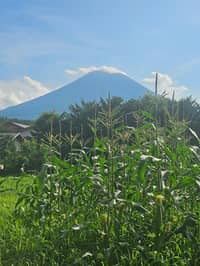
 This page's pick
English guide, hut night
Yoshida Trail, 8th station hut
- Days
- 2 days
- Guide
- English
- Price
- from $375
Guides
Language
EnglishCurrency
US dollar · $GetYourGuide shows prices in the currency you choose.
Guide · Climbing
Reaching the summit at 3,776 m is a real mountain climb with a short summer season and firm rules. Here is what the official climbing site sets out, and how guided climbs work.
Editorial team, mount-fuji-tour.comUpdated October 22, 20266 minutes to read57 sources
The short version
A Mount Fuji hike is a high-altitude climb to 3,776 m, not a stroll from a car park.5 The official climbing site, run for the Ministry of the Environment and the Yamanashi and Shizuoka prefectures, lists four trails, each starting at a 5th station, and calls proper equipment and preparation essential.65 Japan's tourism organization counts roughly 300,000 climbers each summer.7
The Mount Fuji climbing season is short. In 2026 the Yoshida Trail on the Yamanashi side opened on 1 July and closed on 10 September, and the Subashiri Trail opened on the same day.18 The Fujinomiya and Gotemba Trails on the Shizuoka side opened on 10 July and closed on 10 September.8
For future seasons the official site gives early July to early September and says the exact dates are announced before the season starts.9 Outside the season all trails to the summit are closed, and climbers must submit a climbing plan; the site absolutely does not recommend climbing then.1011
A guided two-day climb
Day 1, 7:10 AM
At the Shinjuku Post Office, leaving at 7:30 AM.
About 11:00 AM
From the Fuji Subaru Line 5th Station on the Yoshida Trail.
About 4:00 PM
At the 8th or Original 8th station, for dinner and rest.
Day 2, about 2:00 AM
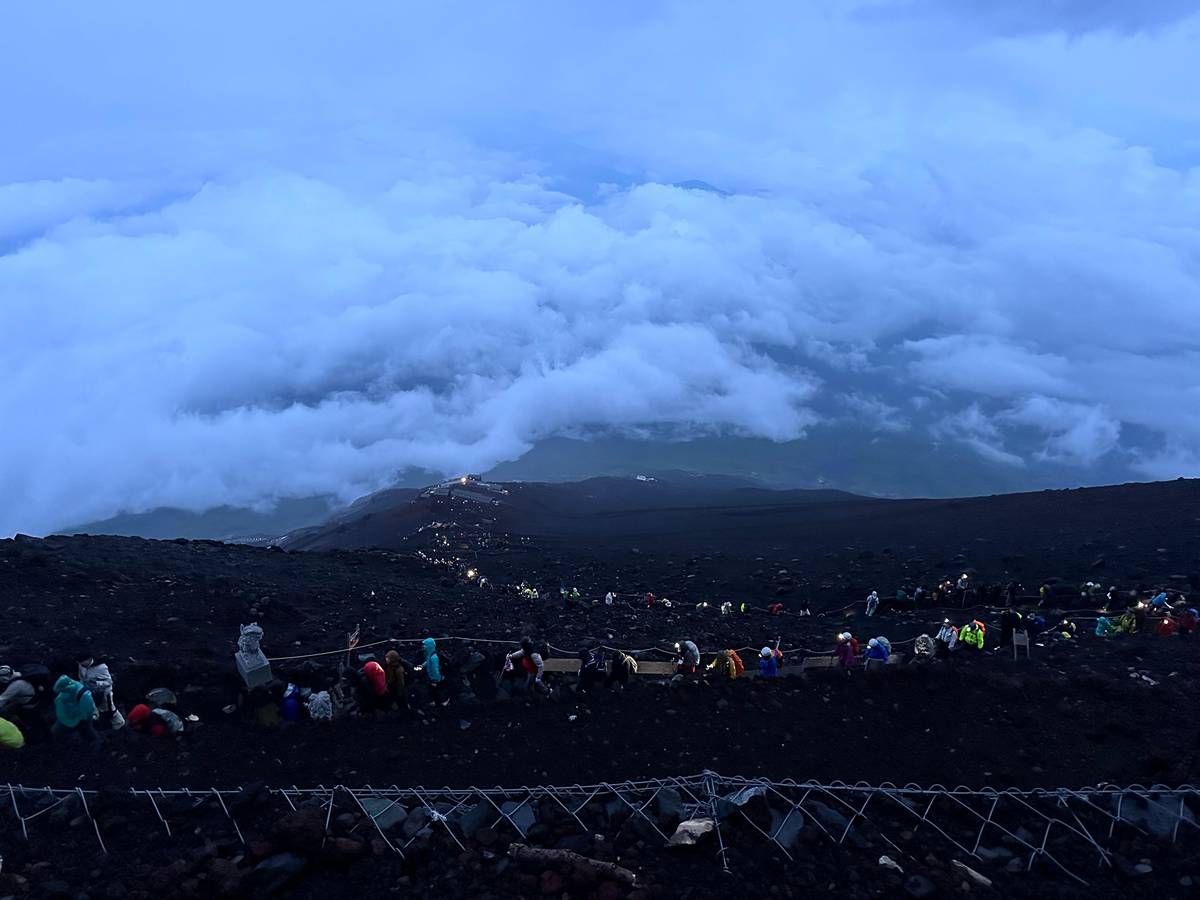
The final climb in the dark with headlamps.
About 5:00 AM
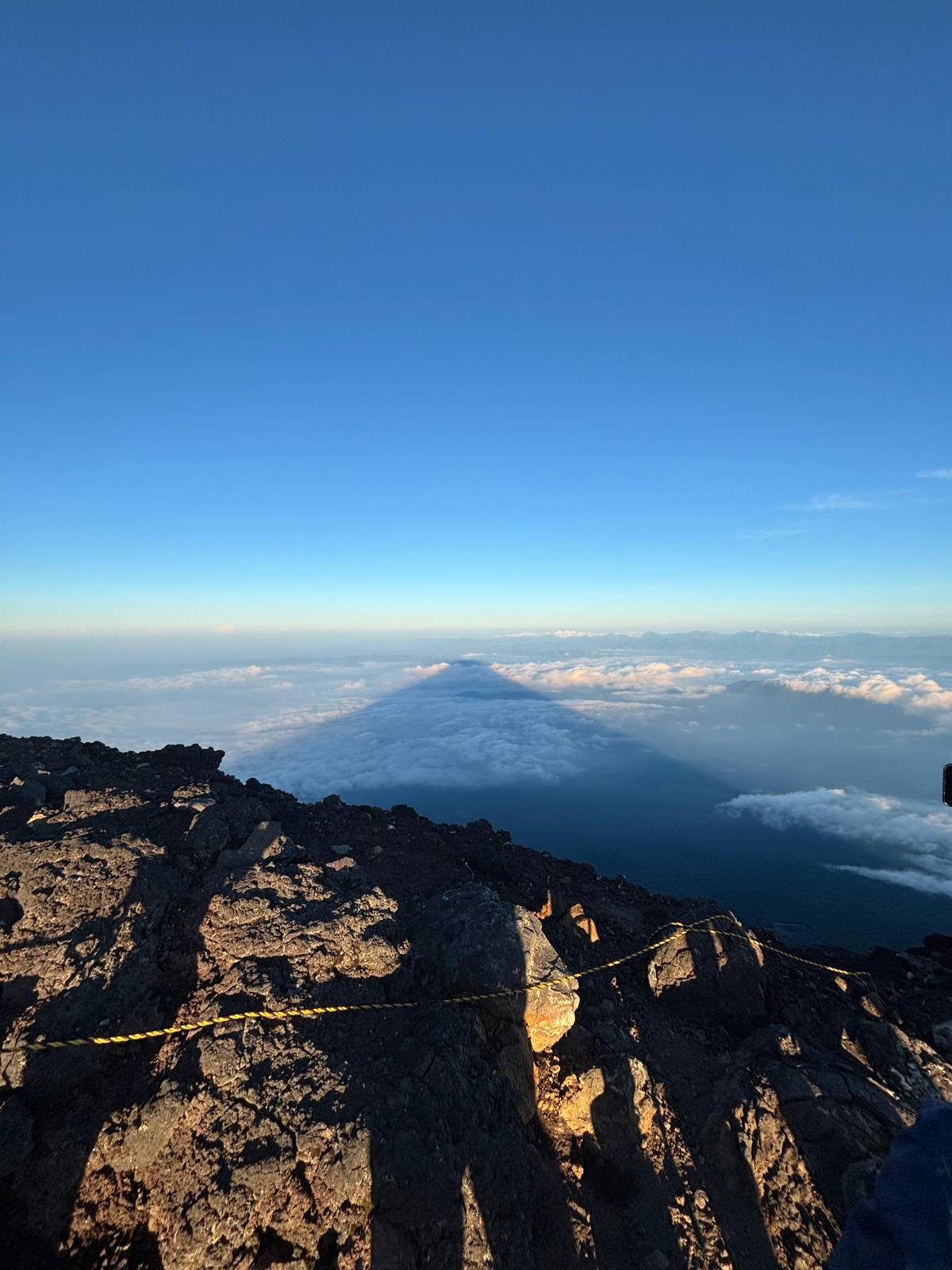
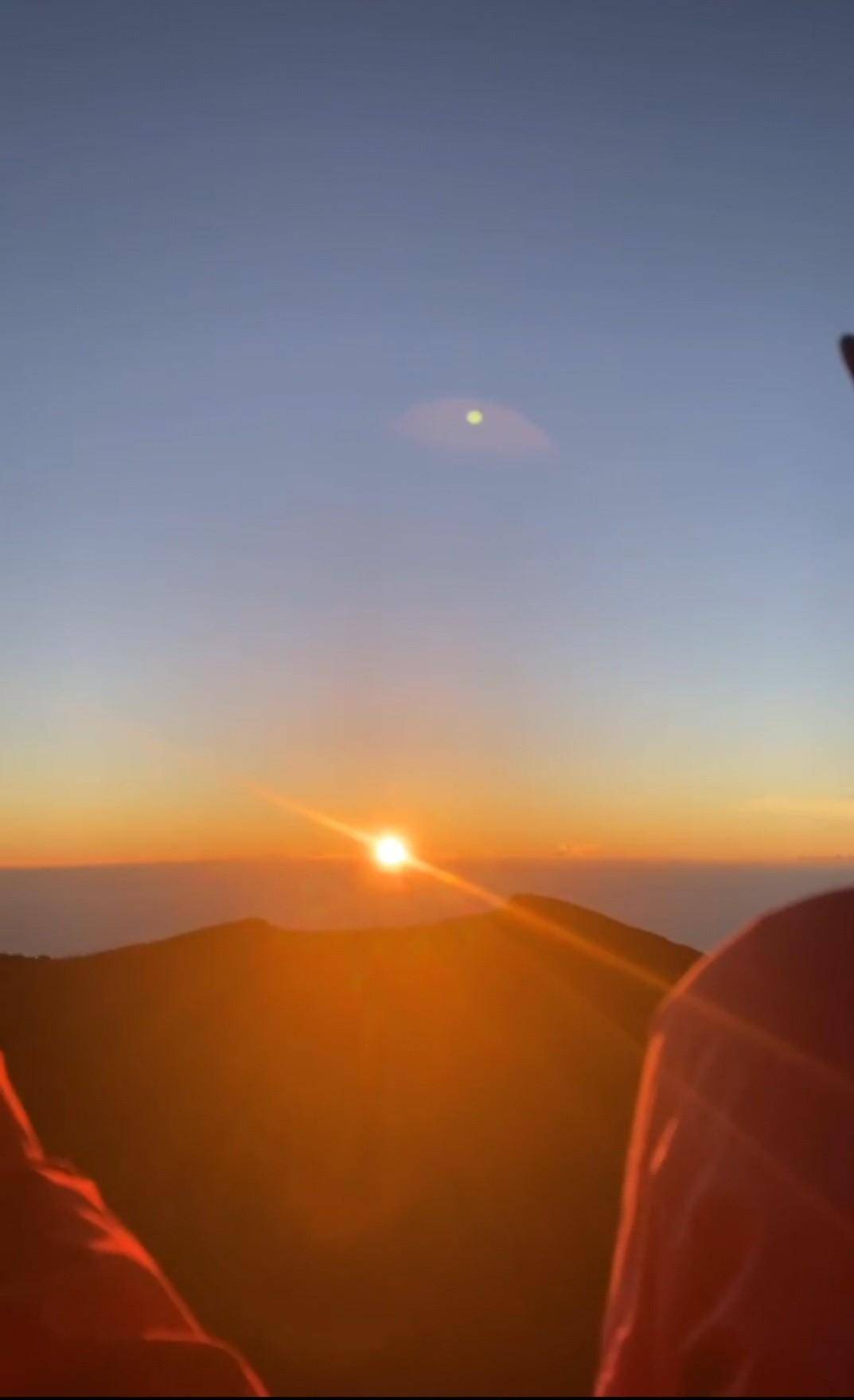
On top for the sunrise, then the descent begins.
About 5:30 PM
After a hot spring stop on the way home.
The Mount Fuji Yoshida Trail is the most popular route. It starts at the Fuji Subaru Line 5th station at 2,305 m and climbs about 1,450 m to the summit, 6.8 km up in about 6 hours and 7 km down in about 4.124 The site considers it easier for beginners because of its many mountain huts.13
The Fujinomiya Trail is the shortest, from the highest trailhead at 2,400 m, with about 1,320 m to climb and 4.3 km up in about 5 hours.1415 The Subashiri Trail starts at 2,000 m in forest and takes about 7 hours up, while the Gotemba Trail begins far lower, at 1,440 m, and needs about 9 hours for its 10.5 km.1617
Whichever you choose, the top is the same hard ground. The official site warns that all routes near the summit, above 3,000 m, involve steep rocky slopes and unpredictable weather.18 Choose the Yoshida Trail for huts and company, Fujinomiya for the shortest distance, and Subashiri or Gotemba only if you want quieter paths and have time.
The four trails
| Trail | Trailhead | Up | Down | Season 2026 |
|---|---|---|---|---|
| Yoshida | 2,305 m | 6.8 km, about 6 hrs | 7 km, about 4 hrs | 1 July to 10 Sept |
| Fujinomiya | 2,400 m | 4.3 km, about 5 hrs | 4.3 km, about 3 hrs | 10 July to 10 Sept |
| Subashiri | 2,000 m | 6.9 km, about 7 hrs | 6.2 km, about 4 hrs | 1 July to 10 Sept |
| Gotemba | 1,440 m | 10.5 km, about 9 hrs | 8.4 km, about 4 hrs | 10 July to 10 Sept |
From the official Mt. Fuji climbing website: the comparison of routes and the 2026 season dates; next season's dates are announced before it opens.4151617189
Guided climbs
This page's pickYoshida Trail, 8th station hut
 Most reviewed
 Small group
Decision helper
Match your plan to a trail or a guide
Easier for beginners thanks to the many huts.13
English guide, hut night at the 8th station.
A small group limited to 15, Japanese guides.
Hakone, Lake Yamanaka and Oshino Hakkai in 10 hours.
Even in summer, temperatures at the mountaintop can drop to near 0 degrees Celsius before sunrise.
The hiking fee is 4,000 yen per person, paid once per climb, and the official site says it is a flat rate regardless of the climber's age.220 How much does it cost to climb Mount Fuji in all, then? Add transport to the 5th station, a hut night if you take one, food and water bought on the mountain, and gear you rent or bring.
The entry rules are the same on every trail. Between 2 PM and 3 AM the next morning you may not enter the mountain from the 5th station unless you are staying at a mountain hut.321 On the Yoshida Trail a gate at the trailhead enforces this, and climbers without a hut booking cannot pass after 2 PM or once 4,000 people have entered that day.2223
The reason is safety. The site explains that people climbing through the night without a hut, only to see the sunrise, risk altitude sickness and hypothermia.24 On the Shizuoka trails climbers also complete short pre-climb training on rules and manners, through an app or on site.25
Map
First the whole way from Tokyo with Hakone and Kamakura, then the five lakes at the north foot, then the four 5th stations around the summit.
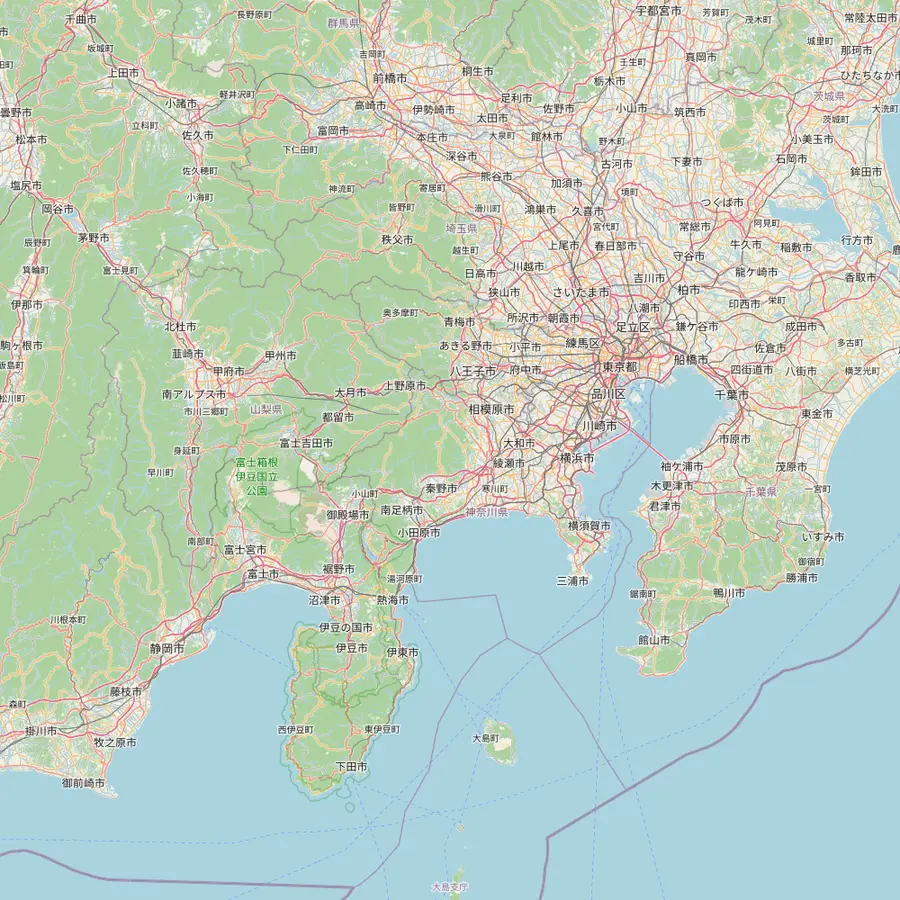 1Tokyo Station2Shinjuku3Kengamine summit4Kawaguchiko Station5Owakudani6Great Buddha, Kamakura
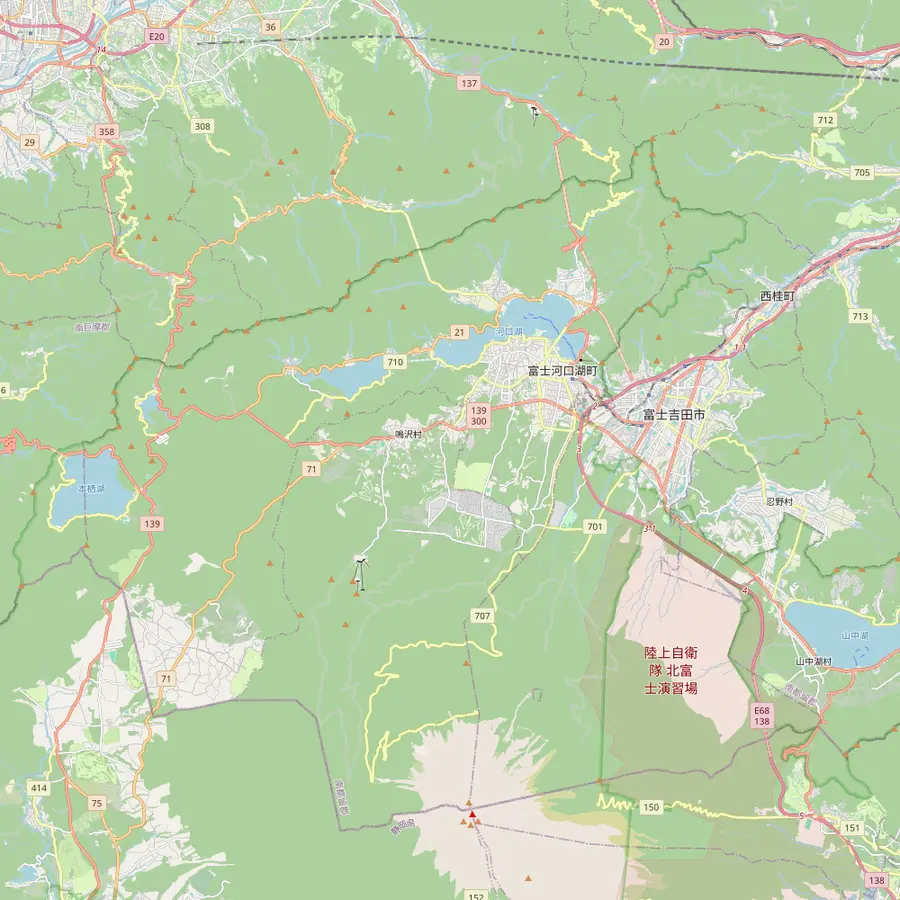 4Kawaguchiko Station7Oshino Hakkai8Lake Yamanaka swan shore9Chureito Pagoda10Oishi Park11Lake Sai12Lake Shoji13Lake Motosu
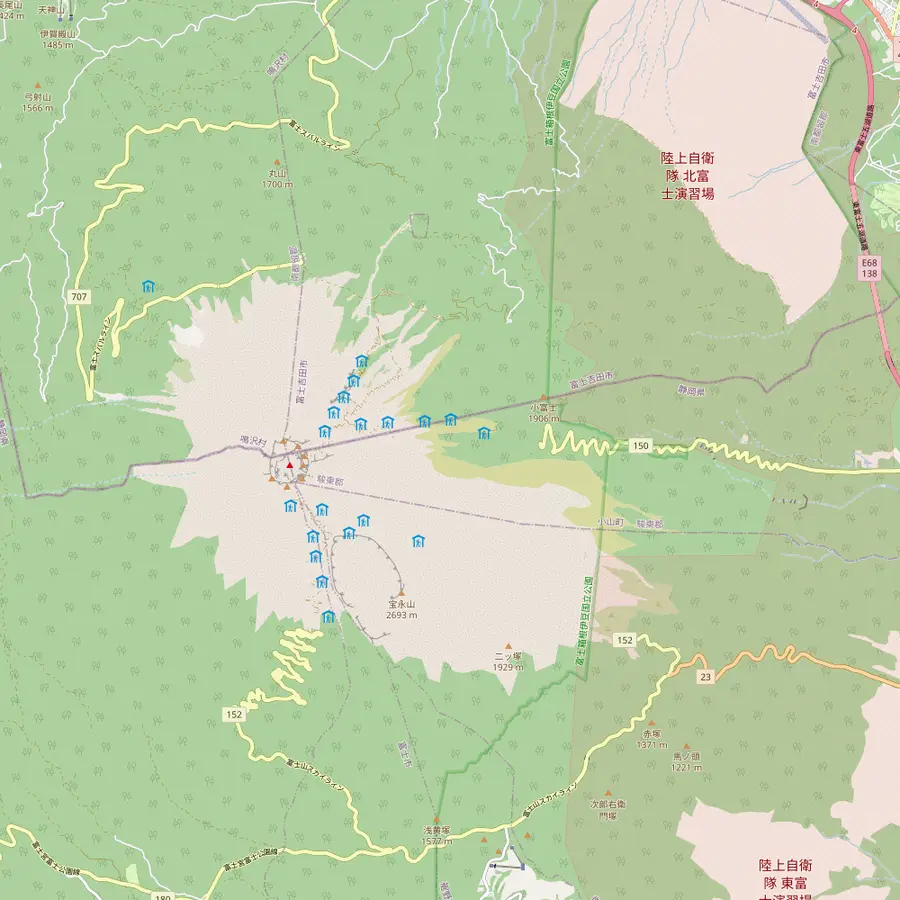 3Kengamine summit14Subaru Line 5th Station15Fujinomiya trailhead16Subashiri 5th Station17Gotemba New 5th Station18Hoei crater
Meeting point of the site tour at 8:00 AM, about 101 km in a straight line from the summit.26
In Google Maps ↗Second meeting point at 8:30 AM; the free 45th-floor observatories of the Tokyo Metropolitan Government stand here.27
In Google Maps ↗The highest point of Mount Fuji, 3,776 m, on the crater rim.28
In Google Maps ↗End of the Fujikyu line, 26.6 km from Otsuki; buses from Shinjuku get here in just under two hours.2930
In Google Maps ↗A 50-minute guided stop of the site tour, reached on the Hakone Ropeway.
In Google Maps ↗A bronze Buddha some 11.3 m tall, begun in 1252, about 74 km east of the summit.313233
In Google Maps ↗Eight spring ponds, a national natural monument since 1934 and part of the World Heritage site.34
In Google Maps ↗Lake Yamanaka is the nearest lake to Fuji; the site tour stops 20 minutes at its swan shore.35
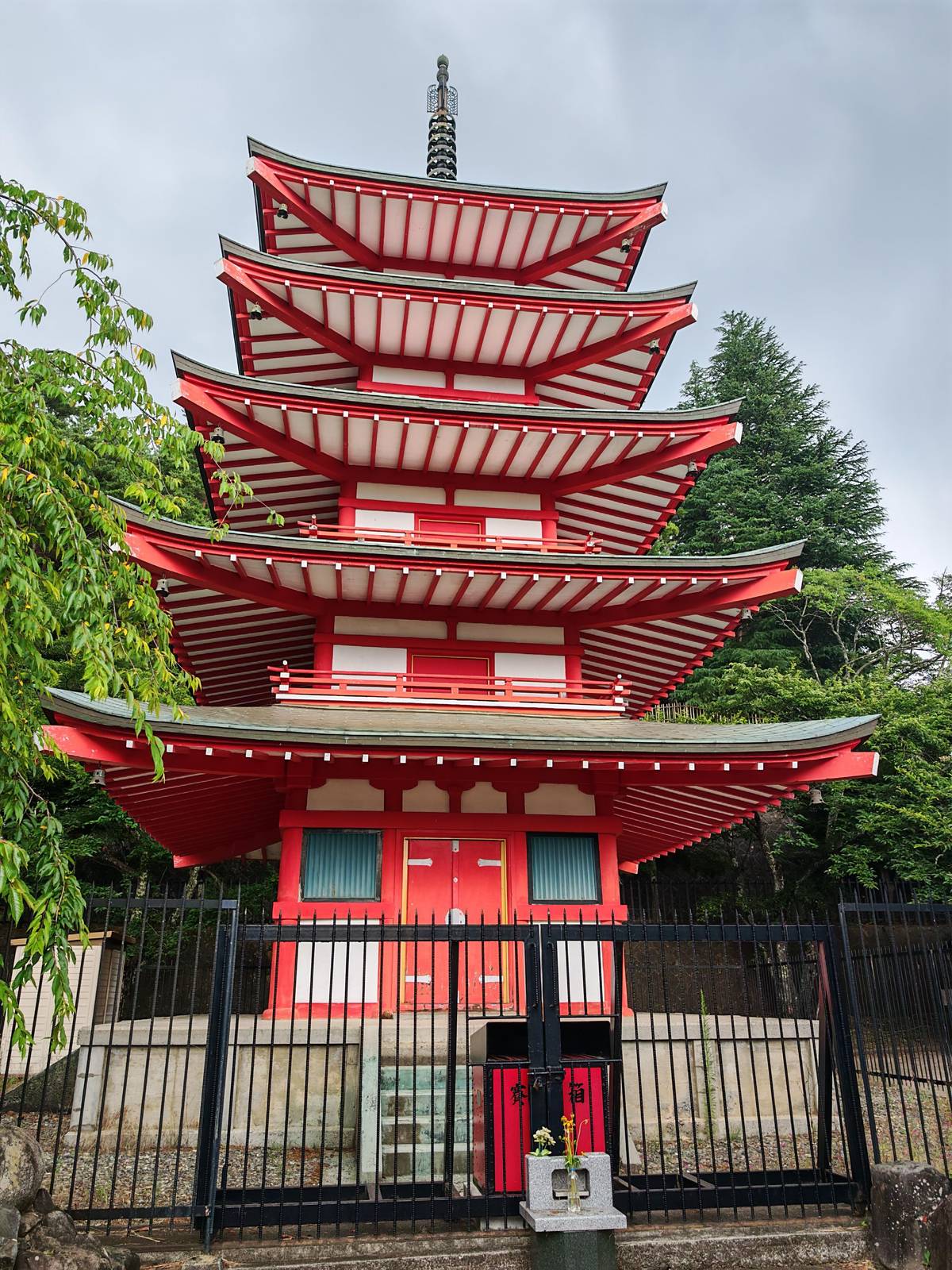
In Google Maps ↗Up 398 steps in Arakurayama Sengen Park, about 25 minutes on foot from Shimoyoshida Station.3637
In Google Maps ↗A Lake Kawaguchi park where Fuji rises behind lavender in early summer.38
In Google Maps ↗Split off an older lake by the lava of the Jogan eruption of 864.39
In Google Maps ↗The smallest of the Fuji Five Lakes, known for its Upside-down Fuji reflection.4041
In Google Maps ↗The deepest of the five lakes and the view on the 1,000-yen note.4243
In Google Maps ↗Start of the Yoshida Trail at 2,305 m, with the climbers' gate and Komitake Shrine.42244
In Google Maps ↗Trailhead at 2,000 m; in 2026 the Subashiri Trail opened on 1 July.168
In Google Maps ↗Trailhead at 1,440 m; the way up is 10.5 km, about 9 hours.17
In Google Maps ↗The southeast-flank crater of the eruption that began on 16 December 1707.45
In Google Maps ↗Kit list
Cost calculator
Enter your group size, then check if the hiking fee is included.
Total from$750
per participant from $375
Check availabilityfree cancellationTotals here are a quick sum: the listing's GetYourGuide from-price times your party size, turned into your currency at the ECB rate for today. The final amount appears only at checkout.
Video
The video loads only when you tap play.
How long it takes to climb Mount Fuji depends on the trail and on you. The official estimates run from about 5 hours up on the Fujinomiya Trail to about 9 hours on the Gotemba Trail, plus 3 to 4 hours to come down.1517 Guided climbs split it over a pair of days with a night in a hut.
A typical guided plan shows the rhythm. One two-day climb meets in Shinjuku at 7:10 AM, starts walking from the Subaru Line station about 11:00 AM, reaches a hut at the 8th station about 4:00 PM, leaves again about 2:00 AM and stands on the summit about 5:00 AM for the sunrise. It is back at the 5th station about 11:00 AM and in Shinjuku about 5:30 PM.
Tents are not allowed anywhere on the mountain, so the hut is the only place to sleep.46 Huts are simple and shared: the guided listing above describes its hut as a mixed dormitory with a very compact space per person. Book well ahead for weekends, which the site warns are very crowded.47
The summit is cold even in August. The Japan Meteorological Agency's normals for its summit station give a daily high of 9.5 °C and a low of 3.8 °C in August, and 8.0 °C and 2.8 °C in July.4849 Before sunrise the top can drop to near 0 °C, and the longer you wait for the sun, the colder you get.19
Temperature falls by about 0.6 °C for every 100 m of height, which turns a hot day at the lakes into winter at the crater.50 Pack the warm layers the official site lists, a fleece, a down jacket, gloves and a neck warmer, and keep them at the top of your bag.51
Altitude sickness is the other risk. Climb slowly, drink, rest at the huts and do not race up through the night. The official site links overnight climbs without a hut to altitude sickness and hypothermia, and the night gate exists for that reason.24 If you feel a strong headache or nausea, turn back.
This page recommends a two-day climb with an English-speaking guide on the Yoshida Trail and a night in a hut at the 8th or Original 8th station. It has 86 reviews averaging 4.28 and starts from $375; the 4,000-yen hiking fee is not included and is paid on site. It takes climbers aged 6 to 70 after a health check.
Read its weather terms: the climb runs in rain but may be cancelled for safety with no refund. Another two-day climb by the Yoshida Trail uses Japanese mountain guides, groups of up to 49 and a cancellation window of 7 days. A third goes up the Fujinomiya Trail via the Hoei crater with a small group limited to 15.
Our featured site tour is not a climb. It is a 10-hour coach day to Hakone, Lake Yamanaka and Oshino Hakkai that never goes up the mountain. It suits the days before or after a climb, or travelers who want to see Fuji without the summit.
Mount Fuji is a World Heritage site and the area above the 5th station is a National Park Special Protection Area.52 Taking any stone, even a pebble, is prohibited, and there are no trash cans on the trails or in the huts, so everything you carry up comes down with you.5354
Drones and paragliders are banned above the 8.5th station by the landowner, Fujisan Hongu Sengen Taisha.55 Bring plenty of cash and 100-yen coins for huts and toilets, as the mountain runs on cash, and there is no ATM at the 5th station.5657
Plan the season carefully. The Mount Fuji climbing season brings most climbers from mid-July, with crowds at weekends and in the Obon holidays.47 A weekday early in the season, with a hut booked and a forecast checked, gives you a calmer trail and time to wait out a cloudy morning.
Your day at Fuji
Meet at Tokyo Station or Shinjuku, pick a date, and cancel free up to 24 hours before.
In summer only. In 2026 the Yoshida and Subashiri Trails were open from 1 July to 10 September; the Fujinomiya and Gotemba Trails opened on 10 July.18
4,000 yen per person. Paid once per climb, a flat rate regardless of age, under the 2026 rules.220
Only with a hut booking. Entry from 2 PM to 3 AM is allowed only for mountain-hut guests.3
The Yoshida Trail. The official site calls it easier because of its many mountain huts.13
Near freezing at dawn. The August normal at the summit station is a high of 9.5 °C and a low of 3.8 °C.4819
No. Tent pitching is not permitted; climbers stay in mountain huts.46
Not on this page's pick. The 4,000-yen fee is paid on site for that guided two-day climb.
Sources