Guides
Language
EnglishCurrency
US dollar · $GetYourGuide shows prices in the currency you choose.
Guide · Getting there
Mount Fuji from Tokyo: how far it is and how to get there
The mountain looks close on a clear day, and it is: about two hours by train or bus to the lakes at its foot. Here are the routes, the times and the traps.
Editorial team, mount-fuji-tour.comUpdated October 22, 20266 minutes to read43 sources
Quick answer
- 01Distance
- About 101 km in a straight line from Tokyo Station to the summit.1
- 02Fastest train
- The direct Fuji Kaiyu from Shinjuku reaches Kawaguchiko in 1 hour 53 minutes.2
- 03By bus
- From the Shinjuku terminal to Kawaguchiko Station in just under two hours.3
- 04Rail pass
- The JR pass is not accepted on the Fuji Kyuko line beyond Otsuki.4
- 05No planning
- A coach tour drives 2 hours each way and handles every stop.
Where you are actually going
When people talk about going to Mount Fuji from Tokyo, they rarely mean the summit. They mean the Fuji Five Lakes at its northern foot, in southeastern Yamanashi Prefecture near the border with Shizuoka, or the 5th stations high on its flanks.5 Kawaguchiko is the easiest lake to reach from Tokyo and the core of sightseeing there.6
That matters for planning, because the answer to almost every transport question is Kawaguchiko Station. Trains and expressway buses from Tokyo end there, and from the station you continue by local bus or on foot to the lakes, the pagoda and the spring ponds.
The summit is a different trip altogether. It is reached only on foot, in the summer climbing season, from one of four 5th stations around the mountain.7 If climbing is your plan, read our separate guide to the hike; this page is about getting to the foot of the mountain and back. Think of it as a day out to a lake district under a volcano: the travel is easy, the views are big, and the main decision is whether you go on your own or let a coach do the work.
By train, step by step
Shinjuku to Kawaguchiko without a tour
-
Before the day
Reserve a seat
The Fuji Kaiyu has no unreserved seats.8
-
Morning
Leave Shinjuku
The direct express runs through to Kawaguchiko.2
-
Or via Otsuki
Change trains
JR Chuo Line to Otsuki, then the Fuji Kyuko line.4
-
Last stretch
Climb to the lakes
About 45 minutes from Otsuki on the View Express.9
-
Arrive
Kawaguchiko Station
The hub for the lakes, 26.6 km from Otsuki.10
The distance in kilometers and in hours
How far is Mount Fuji from Tokyo, then? The Geospatial Information Authority of Japan's geodesic calculator gives 100,777 m from the summit to Tokyo Station, about 101 km, and about 95 km to the Tokyo Metropolitan Government Building in Shinjuku.111 The roads are longer than the straight line, of course, and they climb from the Tokyo plain into the hills of Yamanashi, so the journey time depends far more on traffic and connections than on distance.
In hours, Japan's national tourism organization gives about two hours by bus from Tokyo Station and about three hours by regular train.12 The fastest scheduled option is a direct limited express from Shinjuku, timed at 1 hour 53 minutes to Kawaguchiko at best.2
On a tour, the coach covers the same distance. Our featured day lists 2 hours on the bus each way, and the rest of the day goes to the stops. Holiday traffic can stretch that: the operator warns that returns can run after 8 PM, so do not book a dinner reservation for the same evening. The same applies to independent travel: a train timetable is reliable, but a bus on a holiday weekend is only as fast as the expressway.
Routes in
From Tokyo to the lakes and back
| From | To | How | Time |
|---|---|---|---|
| Shinjuku | Kawaguchiko | Fuji Kaiyu limited express | 1 hr 53 min at best |
| Tokyo | Otsuki, then Kawaguchiko | JR Chuo Line, then Fujikyu line | about 45 min from Otsuki |
| Shinjuku bus terminal | Kawaguchiko | Expressway bus | just under 2 hrs |
| Tokyo Station | Fuji area | Bus | about 2 hrs |
| Odawara | Tokyo Station | Bullet train on a tour | about 34 min |
| Tokyo or Shinjuku | Hakone and the lakes | Tour coach | 2 hrs each way |
From the Fujikyu Railway, the Japan National Tourism Organization and the tour listings named on this page; check timetables before you travel.29312
Decision helper
Train, bus, car or tour?
Match your day to the way in
The pass is not accepted on the Fuji Kyuko line.4
Shinjuku to Kawaguchiko in just under two hours.3
Hakone, Lake Yamanaka and Oshino Hakkai in 10 hours.
The Subaru Line was closed to private cars from 3 July to 10 September 2026.14
Alternatively, you can take a bus to Kawaguchiko Station from Shinjuku Expressway Bus Terminal. The ride takes just under two hours.
By train: the direct express or a change at Otsuki
The rail route runs west from Tokyo on the JR Chuo Line to Otsuki, where you change to the Fuji Kyuko line; the JR Rail Pass is not accepted on that second line.4 The private line is 26.6 km long and climbs about 500 m from Otsuki to Kawaguchiko.10
The easiest version is the limited express Fuji Kaiyu, which runs from Shinjuku straight through to Kawaguchiko. It makes four round trips a day, with one more in some seasons, and has no unreserved seats, so you need a seat reservation.158 Its fastest run takes 1 hour 53 minutes.2
If you change at Otsuki instead, the Fujisan View Express covers the last stretch to Kawaguchiko in about 45 minutes.9 Watch the windows as the train climbs: the mountain fills more and more of the view, and the line passes Shimoyoshida, the station for the Chureito Pagoda.16
Map
From Tokyo to the lakes and the trailheads of Fuji
First the whole way from Tokyo with Hakone and Kamakura, then the five lakes at the north foot, then the four 5th stations around the summit.
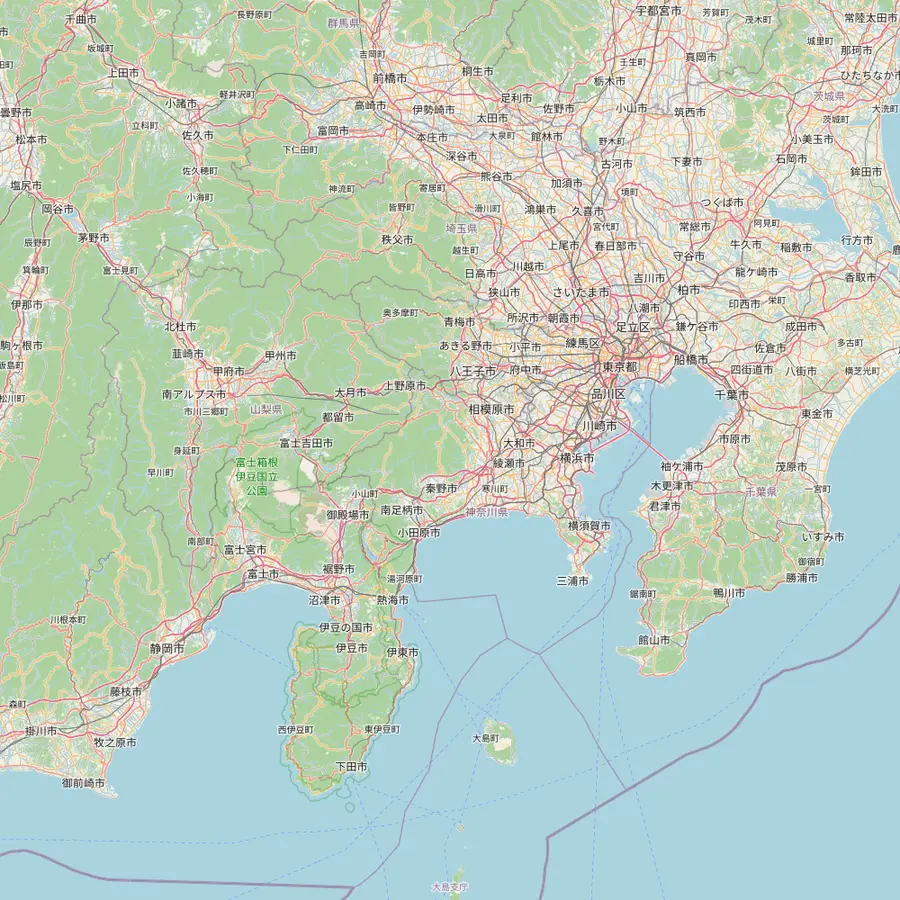 1Tokyo Station2Shinjuku3Kengamine summit4Kawaguchiko Station5Owakudani6Great Buddha, Kamakura
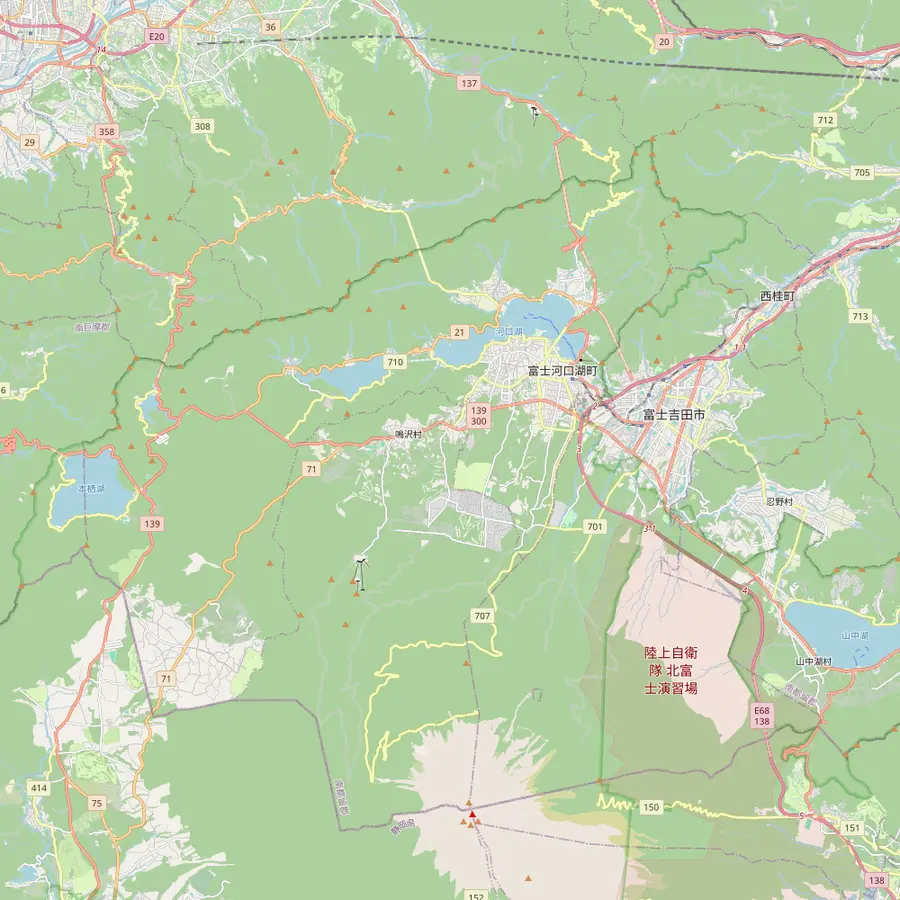 4Kawaguchiko Station7Oshino Hakkai8Lake Yamanaka swan shore9Chureito Pagoda10Oishi Park11Lake Sai12Lake Shoji13Lake Motosu
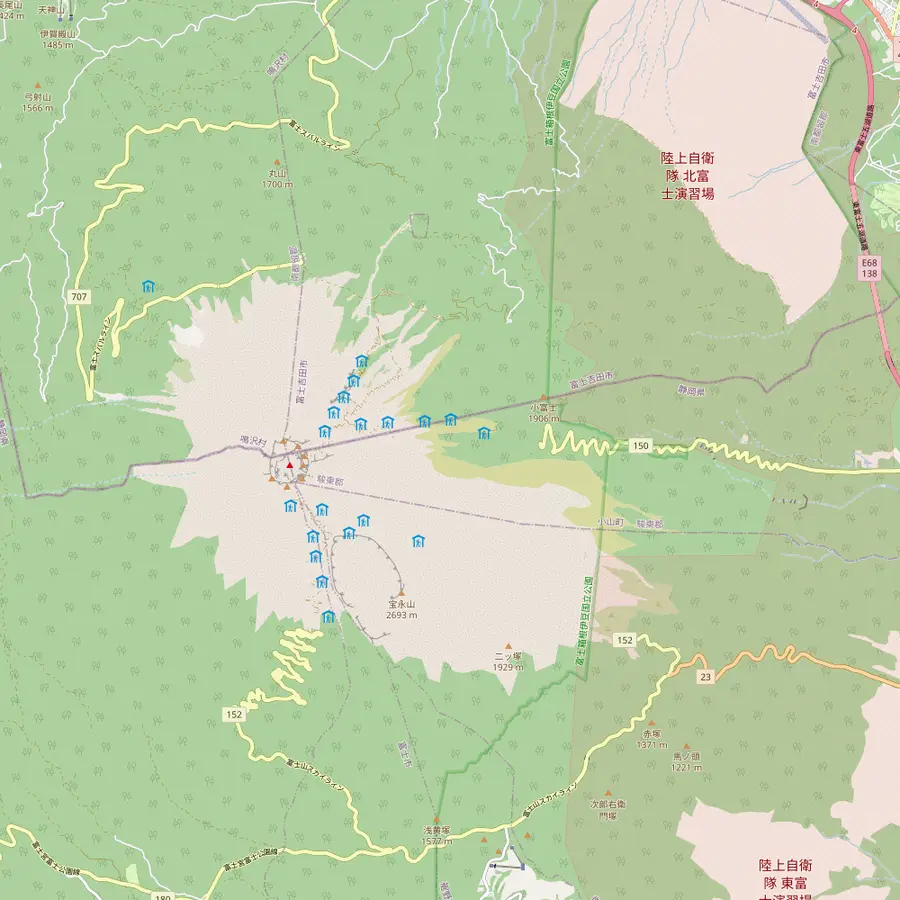 3Kengamine summit14Subaru Line 5th Station15Fujinomiya trailhead16Subashiri 5th Station17Gotemba New 5th Station18Hoei crater
- 1Tokyo Station
Meeting point of the site tour at 8:00 AM, about 101 km in a straight line from the summit.1
In Google Maps ↗ - 2Shinjuku
Second meeting point at 8:30 AM; the free 45th-floor observatories of the Tokyo Metropolitan Government stand here.17
In Google Maps ↗ - 3Kengamine summit
The highest point of Mount Fuji, 3,776 m, on the crater rim.18
In Google Maps ↗ - 4Kawaguchiko Station
End of the Fujikyu line, 26.6 km from Otsuki; buses from Shinjuku get here in just under two hours.103
In Google Maps ↗ - 5Owakudani
A 50-minute guided stop of the site tour, reached on the Hakone Ropeway.
In Google Maps ↗ - 6Great Buddha, Kamakura
A bronze Buddha some 11.3 m tall, begun in 1252, about 74 km east of the summit.192021
In Google Maps ↗ - 7Oshino Hakkai
Eight spring ponds, a national natural monument since 1934 and part of the World Heritage site.22
In Google Maps ↗ - 8Lake Yamanaka swan shore
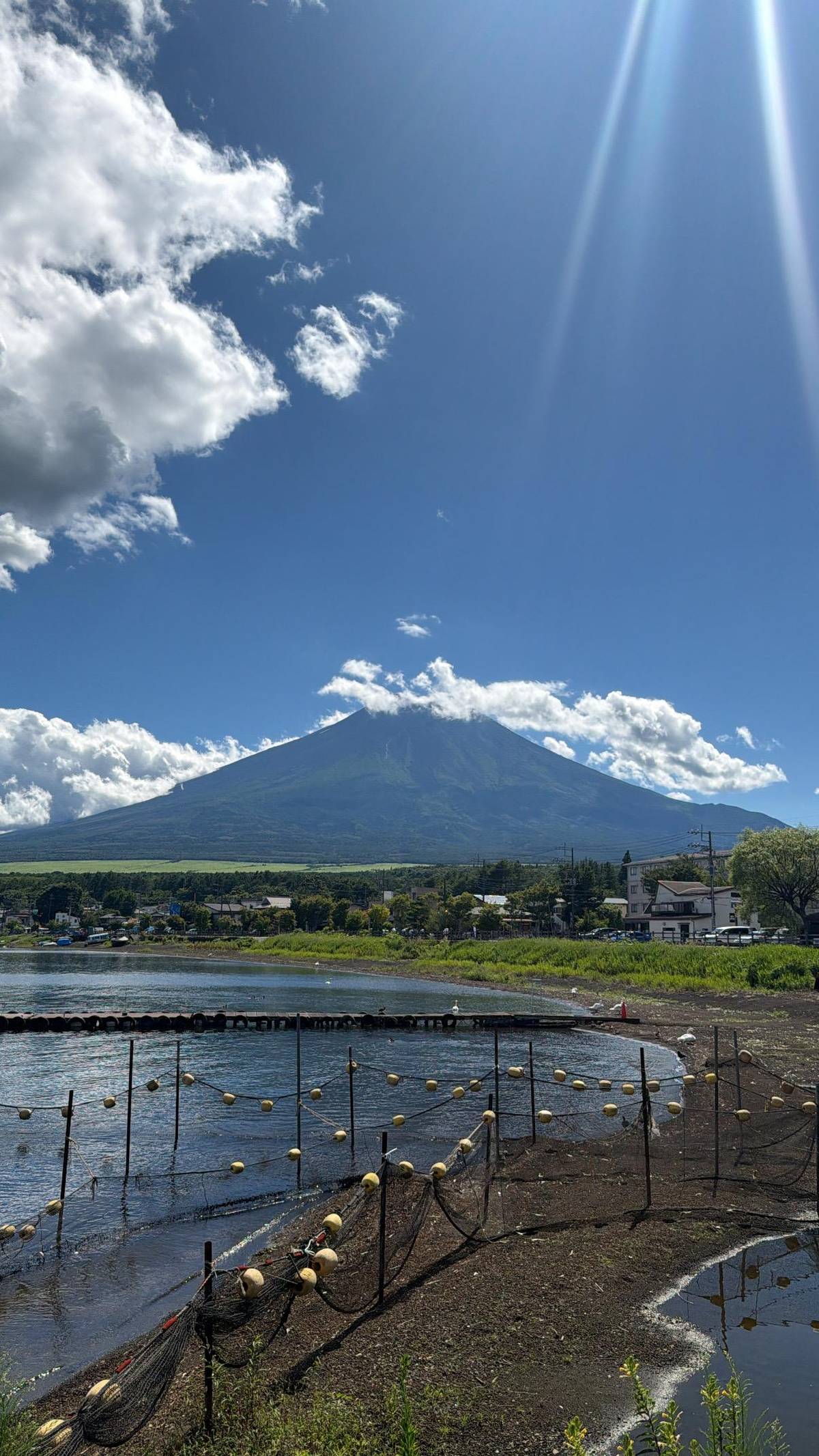
Lake Yamanaka is the nearest lake to Fuji; the site tour stops 20 minutes at its swan shore.23
In Google Maps ↗ - 9Chureito Pagoda
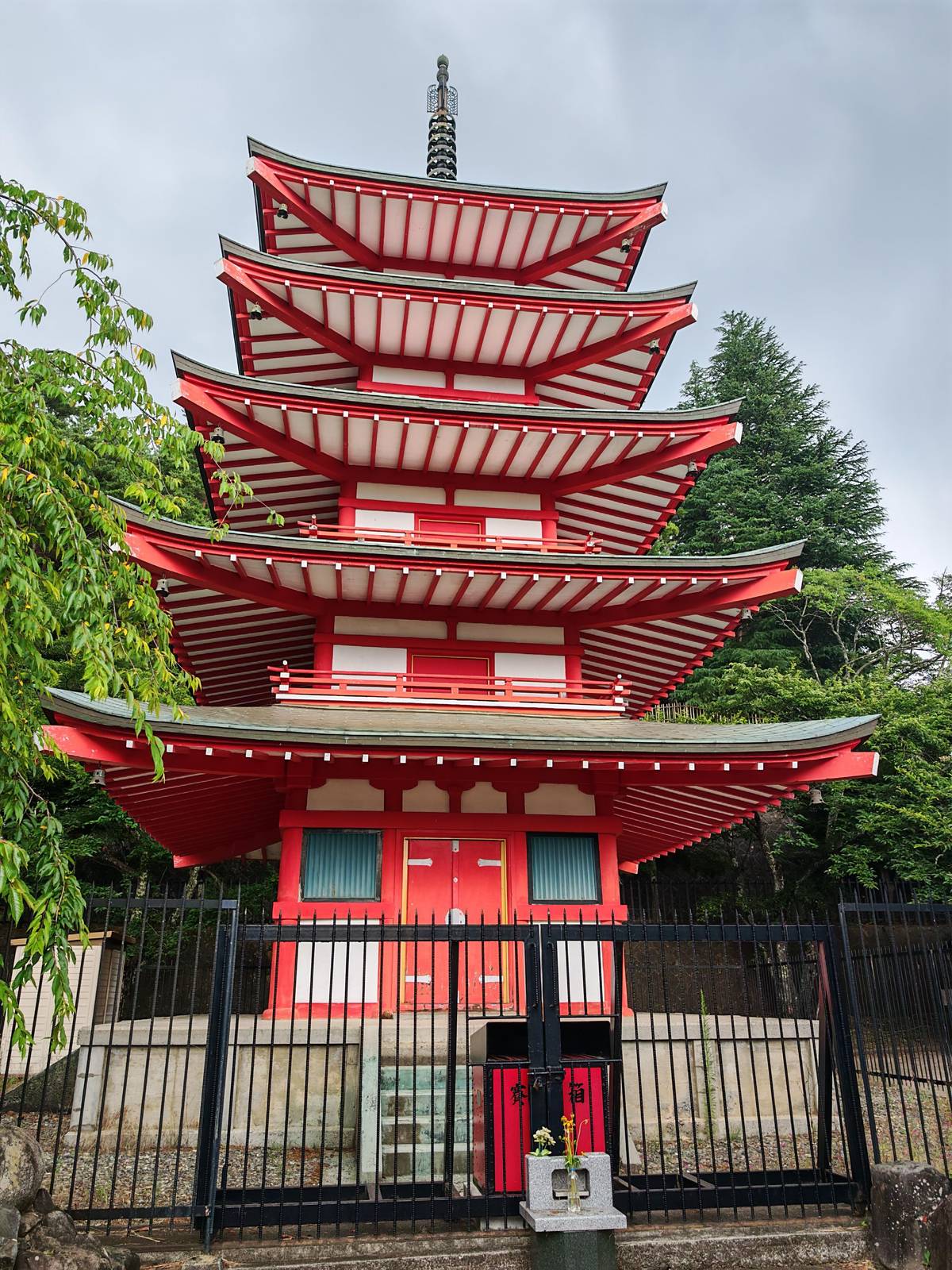
Up 398 steps in Arakurayama Sengen Park, about 25 minutes on foot from Shimoyoshida Station.2416
In Google Maps ↗ - 10Oishi Park
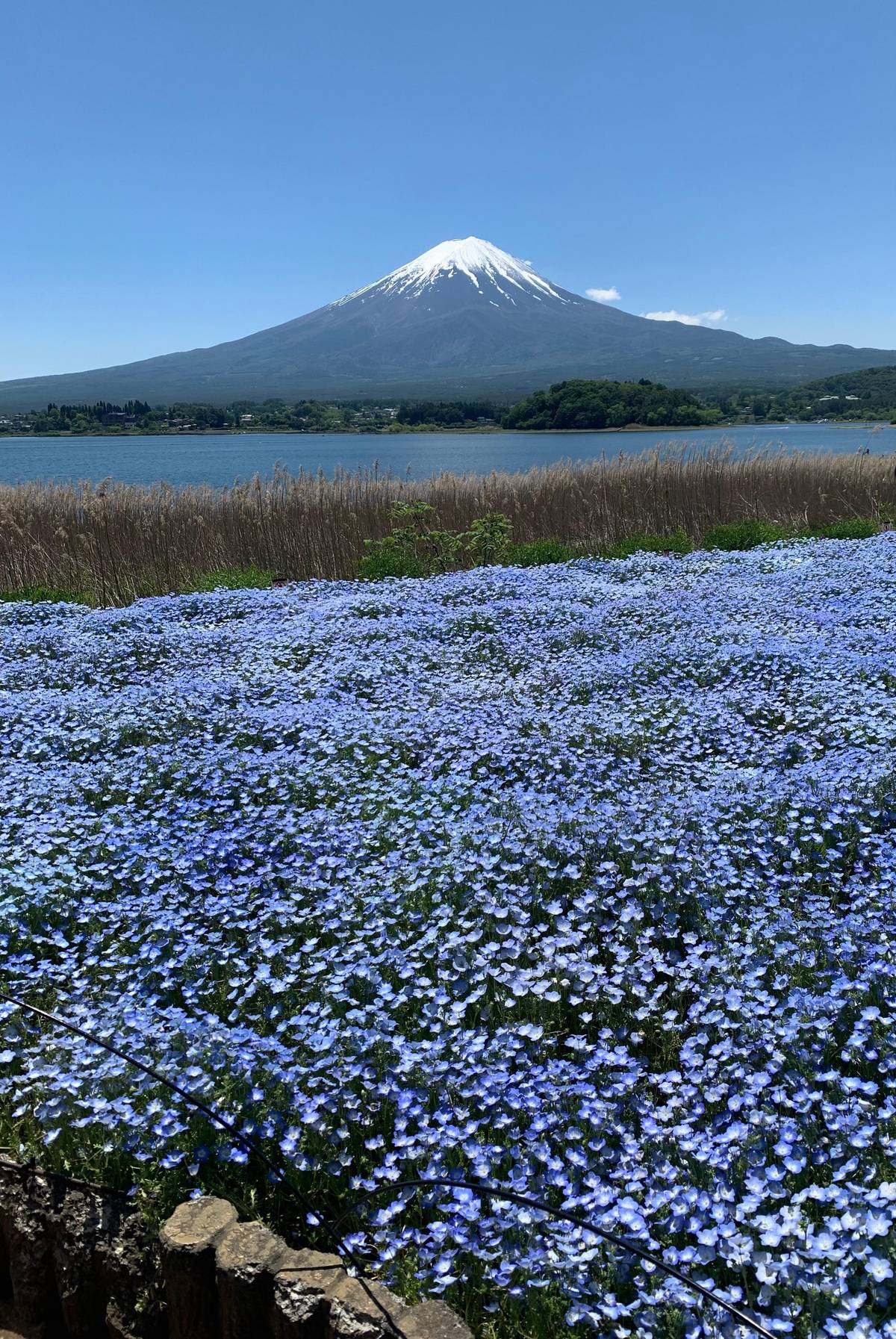
A Lake Kawaguchi park where Fuji rises behind lavender in early summer.25
In Google Maps ↗ - 11Lake Sai
Split off an older lake by the lava of the Jogan eruption of 864.26
In Google Maps ↗ - 12Lake Shoji
The smallest of the Fuji Five Lakes, known for its Upside-down Fuji reflection.2728
In Google Maps ↗ - 13Lake Motosu
The deepest of the five lakes and the view on the 1,000-yen note.2930
In Google Maps ↗ - 14Subaru Line 5th Station
Start of the Yoshida Trail at 2,305 m, with the climbers' gate and Komitake Shrine.313233
In Google Maps ↗ - 15
- 16Subashiri 5th Station
Trailhead at 2,000 m; in 2026 the Subashiri Trail opened on 1 July.3637
In Google Maps ↗ - 17Gotemba New 5th Station
Trailhead at 1,440 m; the way up is 10.5 km, about 9 hours.38
In Google Maps ↗ - 18Hoei crater
The southeast-flank crater of the eruption that began on 16 December 1707.39
In Google Maps ↗
Checklist
For the journey to Fuji
Before you go
- A reserved seat on the direct express
- The last train or bus back to Tokyo
- A weekday if you can, to dodge traffic
On the day
- Cash or an IC card for local buses
- An early start for clearer views
- A warm layer for the cooler lakes
Cost calculator
Price a tour from Tokyo for your group
Enter your group size to compare tours that handle the journey.
Total from$107
per participant from $54
Check availabilityfree cancellationTotals here are a quick sum: the listing's GetYourGuide from-price times your party size, turned into your currency at the ECB rate for today. The final amount appears only at checkout.
Video
How to Get from TOKYO to MT. FUJI, Kawaguchiko 5 Lakes, by Bus or Train
The video loads only when you tap play.
By expressway bus from Shinjuku or Tokyo Station
Buses are the other everyday way in. From the Shinjuku Expressway Bus Terminal to Kawaguchiko Station takes just under two hours, and from Kawaguchiko you can continue to the other lakes.3 Fujiyoshida, the town below the pagoda, describes itself as about 1.5 hours from central Tokyo by express bus.13
A bus has clear advantages over the train: there is no change, and the seat is guaranteed once you have a ticket. The disadvantage is the road. Weekend and holiday traffic on the expressway can add a lot of time, especially on the way back in the evening.
Book ahead for weekends and holidays and keep an eye on the last departure back to Tokyo. Missing it means a long, expensive taxi or a night by the lake, which is not a bad outcome, but it is better chosen than forced. On a busy day, a seat on an earlier service is worth more than an extra hour at the lake.
The bullet train: where it helps and where it does not
Many travelers ask about going from Tokyo to Mount Fuji by bullet train. The Tokaido Shinkansen is one of the three ways Japan's tourism organization lists for reaching the Fuji area, alongside buses and local trains.12 Its line runs south of the mountain on the Shizuoka side, and it does not reach the Five Lakes.
It is also a scenic ride in its own right. When traveling between Tokyo and Kansai, sit on the right side leaving Tokyo and on the left side coming from Kansai to see the mountain.40 Our guide to seeing Fuji from Tokyo covers that window seat in more detail. For a day at the Five Lakes themselves, though, the train via Otsuki or the expressway bus is the practical choice.
Some tours use the bullet train for the return leg. One day tour of Fuji and Hakone ends with a train from Odawara to Tokyo Station, which the operator times at about 34 minutes, with two trains an hour in non-reserved cars. It costs from $116 and has 1,612 reviews.
By car, and why a tour is often simpler
Driving gives freedom at the lakes, but the mountain road has rules. In 2026 private cars were barred from the Fuji Subaru Line to the 5th station from 3 July to 10 September.14 Outside that window the 5th station is about 50 minutes from the Kawaguchiko interchange.41
Parking at the famous viewpoints is limited and buses cannot reach the car parks at Arakurayama Sengen Park; tour coaches drop guests in front of Shimoyoshida Station instead.42 Add expressway tolls, the hunt for spaces and holiday traffic, and a car only pays off for families or for a stay of several days.
For a single day, a coach tour removes every one of those problems, and you can look out of the window instead of at the road. Our featured tour includes expressway tolls, fuel and parking, meets at Tokyo Station or Shinjuku, and returns you to the same point. It starts from $54, with free cancellation up to 24 hours before.
Which way in suits your day
For a day at the lakes on your own, take the direct express from Shinjuku in the morning, or the bus if the train is full, and return the same way. Reserve the train seat and check the time of the last bus or train back before you set off. Local buses around the lakes link the main sights, but they run to a timetable, so leave room in the plan.
For a day that also covers Hakone, Lake Yamanaka and Oshino Hakkai, public transport becomes a puzzle of connections, and a coach tour is the realistic choice. Our featured tour links them in 10 hours from Tokyo.
For the summit, travel in the climbing season and take a climbers' bus or a guided climb to a 5th station; the rules and the trails are on our hike page. And whichever way you go, start early: the mountain is often clearest in the early morning, before cloud builds around it.43
Your day at Fuji
Hakone, Lake Yamanaka and Oshino in one day.
Meet at Tokyo Station or Shinjuku, pick a date, and cancel free up to 24 hours before.


You ask,we answer.
How far is Mount Fuji from Tokyo?
About 101 km in a straight line. That is the distance from the summit to Tokyo Station on the official geodesic calculator.1
What is the fastest train?
The Fuji Kaiyu from Shinjuku. Its fastest run to Kawaguchiko takes 1 hour 53 minutes, all seats reserved.28
Can I use the JR Rail Pass?
Only as far as Otsuki. The pass is not accepted on the Fuji Kyuko line onward to the lakes.4
How long is the bus from Shinjuku?
Just under two hours. Buses run from the Shinjuku Expressway Bus Terminal to Kawaguchiko Station.3
Does the bullet train go to the lakes?
No, it runs south of the mountain. Japan's tourism organization lists it with buses and local trains as a way to the Fuji area.12
Can I drive to the 5th station?
Not in high summer. In 2026 private cars were barred from the Subaru Line from 3 July to 10 September.14
How long does the tour coach take?
2 hours each way. Our featured tour lists 2 hours on the coach out and 2 back.
Sources
What this text is based on
- 1Geospatial Information Authority of JapanGeodesic distance calculation: Fujisan summit (Kengamine) to Tokyo Station↩
- 2Fujikyu Railway (Fujisanroku Electric Railway)JR/Fujikyu Railway Direct Express Fuji Kaiyu: Shinjuku to Kawaguchiko↩
- 3Japan National Tourism Organization (JNTO)Fuji Five Lakes Area↩
- 4Japan National Tourism Organization (JNTO)Fuji Five Lakes Area↩
- 5Japan National Tourism Organization (JNTO)Fuji Five Lakes Area↩
- 6Japan National Tourism Organization (JNTO)Fuji Five Lakes Area↩
- 7Council for the Promotion of Appropriate Use of Mt. Fuji (official Mt. Fuji climbing website: Ministry of the Environment, Yamanashi and Shizuoka Prefectures)Things you must know before climbing Mt. Fuji↩
- 8Fujikyu Railway (Fujisanroku Electric Railway)JR/Fujikyu Railway Direct Express Fuji Kaiyu: Shinjuku to Kawaguchiko↩
- 9Fujikyu Railway (Fujisanroku Electric Railway)Fujisan View Express↩
- 10Fujikyu Railway (Fujisanroku Electric Railway)Fujikyu Railway Line (top page)↩
- 11Geospatial Information Authority of JapanGeodesic distance calculation: Fujisan summit (Kengamine) to the Tokyo Metropolitan Government Building↩
- 12Japan National Tourism Organization (JNTO)Fujisan: Sacred Place and Source of Artistic Inspiration (UNESCO)↩
- 13Fujiyoshida Tourism Promotion Service (official Fujiyoshida tourist guide)Official Fujiyoshida Tourist Guide (top page)↩
- 14Council for the Promotion of Appropriate Use of Mt. Fuji (official Mt. Fuji climbing website: Ministry of the Environment, Yamanashi and Shizuoka Prefectures)Climbing Season: Operating period for each facility (2026)↩
- 15Fujikyu Railway (Fujisanroku Electric Railway)JR/Fujikyu Railway Direct Express Fuji Kaiyu: Shinjuku to Kawaguchiko↩
- 16Fujiyoshida Tourism Promotion Service (official Fujiyoshida tourist guide)Arakurayama Sengen Park and Chureito Pagoda↩
- 17Japan National Tourism Organization (JNTO)The Top 30 Spots for Viewing Mt. Fuji↩
- 18Japan Meteorological AgencyNational Catalogue of the Active Volcanoes in Japan: 55. Fujisan↩
- 19↩
- 20↩
- 21Geospatial Information Authority of JapanGeodesic distance calculation: Fujisan summit (Kengamine) to the Great Buddha of Kamakura↩
- 22Yamanashi Tourism Organization (official tourism site of Yamanashi Prefecture)忍野八海 (Oshino Hakkai)↩
- 23Japan National Tourism Organization (JNTO)The Top 30 Spots for Viewing Mt. Fuji↩
- 24Fujiyoshida Tourism Promotion Service (official Fujiyoshida tourist guide)Arakurayama Sengen Park and Chureito Pagoda↩
- 25Japan National Tourism Organization (JNTO)The Top 30 Spots for Viewing Mt. Fuji↩
- 26Japan Meteorological AgencyNational Catalogue of the Active Volcanoes in Japan: 55. Fujisan↩
- 27Japan National Tourism Organization (JNTO)The Top 30 Spots for Viewing Mt. Fuji↩
- 28Japan National Tourism Organization (JNTO)Fuji Five Lakes Area↩
- 29Japan National Tourism Organization (JNTO)Fuji Five Lakes Area↩
- 30Japan National Tourism Organization (JNTO)The Top 30 Spots for Viewing Mt. Fuji↩
- 31Council for the Promotion of Appropriate Use of Mt. Fuji (official Mt. Fuji climbing website: Ministry of the Environment, Yamanashi and Shizuoka Prefectures)Comparison of Routes↩
- 32Council for the Promotion of Appropriate Use of Mt. Fuji (official Mt. Fuji climbing website: Ministry of the Environment, Yamanashi and Shizuoka Prefectures)FAQ↩
- 33Fujiyoshida Tourism Promotion Service (official Fujiyoshida tourist guide)Fuji Subaru Line 5th Station↩
- 34Council for the Promotion of Appropriate Use of Mt. Fuji (official Mt. Fuji climbing website: Ministry of the Environment, Yamanashi and Shizuoka Prefectures)Comparison of Routes↩
- 35Council for the Promotion of Appropriate Use of Mt. Fuji (official Mt. Fuji climbing website: Ministry of the Environment, Yamanashi and Shizuoka Prefectures)Comparison of Routes↩
- 36Council for the Promotion of Appropriate Use of Mt. Fuji (official Mt. Fuji climbing website: Ministry of the Environment, Yamanashi and Shizuoka Prefectures)Comparison of Routes↩
- 37Council for the Promotion of Appropriate Use of Mt. Fuji (official Mt. Fuji climbing website: Ministry of the Environment, Yamanashi and Shizuoka Prefectures)[Shizuoka Prefecture Route] Restrictions on climbing Mt. Fuji (2026)↩
- 38Council for the Promotion of Appropriate Use of Mt. Fuji (official Mt. Fuji climbing website: Ministry of the Environment, Yamanashi and Shizuoka Prefectures)Comparison of Routes↩
- 39Japan Meteorological AgencyNational Catalogue of the Active Volcanoes in Japan: 55. Fujisan↩
- 40Japan National Tourism Organization (JNTO)The Top 30 Spots for Viewing Mt. Fuji↩
- 41Fujiyoshida Tourism Promotion Service (official Fujiyoshida tourist guide)Fuji Subaru Line 5th Station↩
- 42Fujiyoshida Tourism Promotion Service (official Fujiyoshida tourist guide)Arakurayama Sengen Park and Chureito Pagoda↩
- 43Japan National Tourism Organization (JNTO)The Top 30 Spots for Viewing Mt. Fuji↩